
Lipedema liposuction
when diet and exercise are not the solution.
LipedemaInfo at a glance
| Duration of the surgery | 2-3 hours |
|---|---|
| Anesthesia | General anesthesia |
| hospital stay | 1 - 2 nights inpatient |
| After the surgery | Compression garments and girdles must be worn for 6 weeks, and physical exertion and exercise are off-limits for 3 months. |
| Risks | Irregularities, insufficient skin retraction, scars, bruising, risk of thrombosis, numbness |
| Socially acceptable | Fit for work after 7 days |
| Costs | from €9,800 per region |
Lipedema is frequently misunderstood—and even more frequently mistreated. Affected women spend years hearing that they should exercise more or eat less. The diseased fatty tissue does not respond to this. It grows independently of body weight, causes pain and a feeling of heaviness—and can only be permanently reduced in one single way: surgically.
I am Dr. Juliane Bodo, a specialist in plastic and aesthetic surgery in Berlin-Charlottenburg. For many years, I have been treating women with lipedema—in my own licensed private clinic, with an exclusively female team. I know the disease, and I know the history that most of my patients bring with them when they come to me for the first time. Nothing needs to be explained or justified here.
What is a lipedema and how does it develop?
Lipedema is a chronic, painful disorder of fat distribution that affects almost exclusively women. What makes it unique is that the pathological fat tissue cannot be eliminated through diet or exercise. It grows regardless of body weight, causes pressure-related and spontaneous pain, and significantly restricts the mobility of many of those affected.
Particularly burdensome is the social dimension. In a world where body fat is almost exclusively equated with a lack of discipline, women with lipedema carry a double burden. The condition is invisible to others—and yet omnipresent for those affected. Many of my female patients report that they went years without a diagnosis or were simply not taken seriously.
Who is the treatment suitable for?
Liposuction for lipedema is an option for women who have a clinically confirmed diagnosis of lipedema. I do not offer initial lipedema diagnoses—the diagnosis must be established beyond doubt prior to surgical planning. Suitable candidates are:
- Women for whom compression therapy and lymphatic drainage no longer provide sufficient relief
- Female patients with severely limited mobility due to the medical findings
- Women with significant distress, even in early stages
Typical Symptoms
Lipedema usually begins gradually—often during puberty, after pregnancy, or during menopause. The thighs, hips, or upper arms become thicker, while the waist and abdomen remain at a normal weight. Typical symptoms include:
- Pain on pressure in the affected tissue—even the slightest touch can be painful
- Sudden pain in advanced stages, without any external trigger
- Feeling of heaviness in the legs, especially towards evening
- Bruises, which occur easily and for no apparent reason
- Edema formation with increasing swelling during the course of the day
- Mental Stress – Shame, social withdrawal, restricted clothing choices
These symptoms are not imaginary. They have a biological basis and have nothing to do with overeating or a lack of exercise.
Diagnosis and staging
A diagnosis of lipedema is based on clinical findings. An experienced physician can usually identify lipedema during a face-to-face consultation and a physical examination. Key steps in the examination include:
- Assessment of fat distribution, symmetry, and tenderness
- Stemmer's sign for ruling out lymphedema
- Medical history regarding the onset of the disease, family history, and hormonal triggers
- Differential Diagnosis: Distinguishing Between Overweight and Lipo-Lymphedema
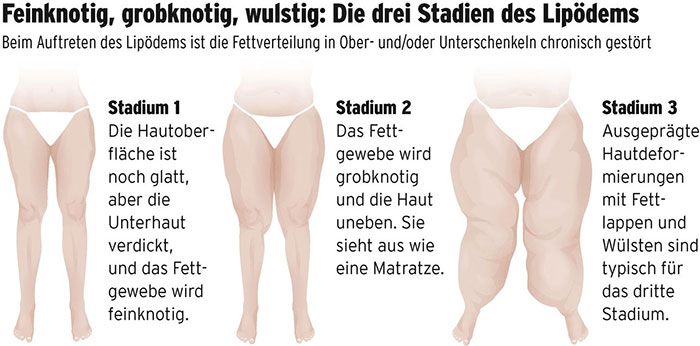
Lipedema is divided into five types
- Type 1 – Buttocks and hips (riding breeches)
- Type 2 – additionally knee region
- Type 3 – down to the ankles (pillar-like legs)
- Type 4 – plus upper arms
- Type 5 – all the way down to the hands and feet
Procedure and Methods
Lipedema liposuction is the only method that permanently reduces the diseased fatty tissue. In my clinic, I perform exclusively tissue-sparing techniques.
Water-jet assisted liposuction (WAL)
With WAL – also known as the body-jet® method – fat cells are gently detached from the tissue matrix using a pulsating water jet before being suctioned out. The surrounding tissue – nerves, blood vessels, and connective tissue – remains largely intact. This means: less swelling, faster healing, and more even results.
Vibration-assisted liposuction (VAL)
VAL works with a slightly oscillating cannula that mechanically loosens the fatty tissue. For pronounced findings or certain body regions, VAL may be the better choice – both techniques can also be combined.
Up to 6 liters of adipose tissue can be removed per procedure. If there are pronounced findings in multiple areas of the body, two or more procedures spaced a few months apart are usually necessary. Depending on the findings, the areas treated are:
- Inner and outer thighs
- Knee region
- Lower leg and ankle (from type 3)
- Hips and buttocks
- Upper arms (from type 4 onwards)
The procedure is performed under general anesthesia with an inpatient stay of one to two nights in my private clinic.
Preparation for the procedure
- Stop blood-thinning medications (e.g., aspirin, ibuprofen) at least ten days in advance
- From midnight before the procedure: no food, no liquids
- Quit nicotine at least four weeks beforehand – smoking significantly impairs wound healing
- Procure compression garments in advance – they are needed immediately after the procedure
- Plan an escort for the journey home and the first few days afterwards
Aftercare & Recovery
- Compression garments: Wear consistently for 6 weeks – day and night
- Physical rest: No sports, no heavy lifting for at least 3 months
- Work capacity: For sedentary activities, usually after 5–7 days
- Final result: Fully visible after 6–12 months, once all swelling has subsided
I personally accompany my patients throughout their entire healing process – with follow-up appointments at my clinic.
Risks & Potential Complications
As with any surgical procedure, complications can also occur with lipedema liposuction:
- Swelling and bruising: Normal after the procedure, subside within a few weeks
- Numbness: Temporarily possible in the treated area, usually resolves on its own
- Contour irregularities: Rarely – tissue-preserving techniques such as WAL and VAL significantly reduce this risk.
- Insufficient skin contraction: Depending on skin elasticity and the size of the finding
- Thrombosis: Statistically low risk, which is discussed in detail during the informed consent consultation
- Scarring: At the cannulation puncture sites – usually very inconspicuous
The inpatient stay at my private clinic allows for a medically supervised first night after the procedure.
Cost of lipedema liposuction in Berlin
- From €9,800 per treated region
- If multiple regions are affected, several procedures are usually necessary – the total costs vary depending on the individual findings.
- Statutory health insurance policyholders with a confirmed diagnosis from stage 3 onwards can submit an application for coverage of costs to their health insurance fund.
During the personal consultation in my private clinic, I will create a treatment plan tailored to your situation with a clear breakdown of costs.
Frequently asked questions about lipedema and lipedema liposuction in Berlin.
Authorized by Dr. Juliane Bodo
Last updated on April 20, 2026