
Breast lift
For a firm, youthful bust
Breast liftInfo at a glance
| Duration of the surgery | Approx. 2–3 hours; surgery under general anesthesia |
|---|---|
| Anesthesia | General anesthesia |
| hospital stay | 1 night |
| After the surgery | 6 weeks postoperative compression bra |
| Socially acceptable | after 1 to 2 weeks |
| Costs | Starting at €9,500 + anesthesia costs without an implant; starting at €11,500 with an implant |
Sagging or drooping breasts are not solely a matter of age. Pregnancy and breastfeeding, significant weight loss, hormonal changes, or implant removal—there are many reasons why breasts lose their former shape. What many women don’t know is that neither exercise nor targeted exercises can reverse these changes. A breast lift—medically known as mastopexy—is the only permanent method for sustainably improving the shape of the breasts.
I am Dr. Juliane Bodo, a board-certified specialist in plastic and aesthetic surgery in Berlin-Charlottenburg. Breast lifts are one of my areas of expertise—and among the most complex procedures in plastic surgery. Many surgeons deliberately avoid this procedure because it requires a high degree of experience and technical precision. I am one of the few experts in Berlin who performs a breast lift with implants in a single step.
What is the goal of a breast lift?
- Tightening the tissue for a more youthful, natural breast shape
- Lifting the nipple to a harmonious position
- Restoring Volume and Shape—Optionally with an Implant
- Long-term, stable results through proven surgical techniques
- A Harmonious Overall Look for Greater Self-Confidence
Breast Lift with or without Implants—Which Method Is Right for You?
The choice of method depends on your individual circumstances and preferences. During the consultation, we’ll work together to determine which option is right for you.
Breast Lift Without Implants
Ideal when the breasts need to be tightened and lifted, but the existing volume is sufficient. In this procedure, excess skin is removed, the glandular tissue is reshaped, and the breasts are repositioned higher—secured in place by what is known as an „internal bra.“ The result: a firm, natural-looking breast without any foreign objects.
Breast Lift with Implants
This is a good option if you want additional volume or a more pronounced cleavage—especially after pregnancy or significant weight loss. The surgical technique is the same as for a lift without implants, but is supplemented with a custom-selected silicone implant. I am one of the few surgeons who can combine both procedures into a single operation—which reduces anesthesia time, recovery time, and costs.
Combination with Breast Reduction
For patients who not only have sagging breasts but also breasts that are too large, I combine a breast lift with a breast reduction. Both procedures are performed during a single surgery.
How is a breast lift performed?
The surgery takes about 2–3 hours and is performed under general anesthesia. We recommend that you stay overnight at my clinic—our team will provide round-the-clock care.
Cutting Techniques – Which One Is Right for You?
Depending on the extent of the sagging, we will work with you to choose the appropriate surgical technique:
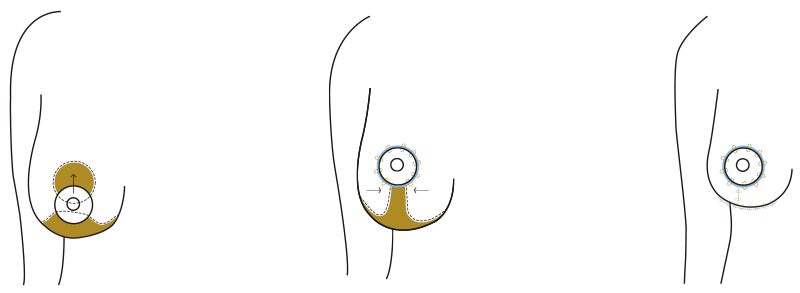
- Periareolar incision (donut technique): A ring-shaped incision around the areola—suitable for minor breast lifts with little excess skin. The scar is discreetly located along the edge of the areola.
- Lejour technique (lollipop incision): An incision around the areola and vertically down to the inframammary fold—proven effective for moderate to extensive breast lifts, without a horizontal scar in the breast fold.
- Anchor incision: In cases of very large breasts or significant sagging, a horizontal incision is also made in the inframammary fold. This technique allows for the greatest degree of lifting and reshaping.
Regardless of the surgical technique chosen, the following principles apply to every breast lift performed at my clinic:
- Nipple Relocation: The nipple, along with its nerves and blood vessels, is gently repositioned to its new, anatomically correct location—sensitivity and the ability to breastfeed are preserved as much as possible.
- Ultra-fine intradermal suturing technique: The wound is closed with very fine sutures placed beneath the skin. This technique minimizes scarring and ensures that the scars fade significantly over time.
With all techniques, the nipple—including its nerves and blood vessels—is gently repositioned. A special intradermal suturing technique minimizes scarring—for most patients, the scars fade significantly over time.
The „inner bra“
A unique feature of my surgical technique: The glandular tissue is secured to the muscle fascia using a special technique and stabilized for the long term. This prevents the breast from sagging again and ensures a lasting, natural-looking result.
GalaFLEX Mesh – When Extra Stability Is Needed
For larger implants or weaker native tissue, I use a GalaFLEX mesh made of poly-4-hydroxybutyrate (P4HB) upon request. This biodegradable mesh provides structural support to the tissue during the first 12–18 months and is gradually replaced by the body’s own collagen—for better long-term results.
Right after a breast lift—what can you expect?
- Mild to moderate pain are possible, but they usually subside within a few days.
- Swelling & Bruising They occur frequently but disappear within the first few weeks.
- Reduced sensitivity in the nipples may occur, but it usually returns to normal after a few months.
- The Final result is only after about. 6 months visible – tissue hardening can extend up to 2 years continue to improve after the surgery.
Depending on your genetic predisposition to wound healing, scars will fade over time and, in most cases, become barely visible. Careful scar care can further support this process.
Recovery Time & Recommended Rest Period
- As a rule, female patients feel better after less than one week back in shape.
- Returning to work: Depending on the job, this is usually possible after 1–2 weeks.
- Supine Position When sleeping: During the first 2 weeks, it is recommended to sleep exclusively on your back so as not to interfere with the healing process.
- Showering & Skin Care: After just a few days Possible—as soon as the stitches and bandages allow it.
Suture Removal & Scar Healing
- Absorbable sutures
- Other sutures remain in place for up to 5 weeks to promote fine, barely visible scarring.
- Scar Care: Special creams or silicone patches can help scars fade more quickly.
Wearing a Support Bra – Why Is It So Important?
- Supports healing & prevents excess Scarring.
- If at least 6 weeks, and should ideally be worn around the clock for 3 months.
- It has to fit perfectly: no constriction, but enough support for the bust.
- Even pressure on the breast tissue promotes a Optimal dimensional stability.
Long-Term Follow-Up Care & Checkups
- Regular checkups are crucial for achieving the best possible results.
- When you are discharged from the clinic, you will receive personalized instructions regarding follow-up care and your individual recovery progress.
- Intense physical activity and sports should be done for at least 6 weekscan be avoided.
Risks & Potential Complications
As with any surgical procedure, complications can occur with a breast lift:
- Postoperative bleeding or impaired wound healing: Rare, but possible—close follow-up care minimizes the risk.
- Infections: Very rare due to sterile working methods and consistent follow-up care.
- Changes in nipple sensitivity: Temporary numbness is common and usually resolves within a few months. In rare cases, the change may last longer.
- Asymmetries: Minor differences are anatomically normal. In cases of pronounced asymmetry, correction is possible.
- Scarring: Depends on a person’s genetic predisposition to wound healing. Consistent scar care helps the scar fade.
- Ability to breastfeed: This is preserved as much as possible with my preferred technique—however, no breast surgery can completely rule out the possibility of losing the ability to breastfeed.
I will discuss all risks with you in detail during a personal consultation before the surgery. No question will be left unanswered.
To minimize the risk of complications from a breast lift, the following general guidelines apply:
- Experienced Board-Certified Specialist in Plastic and Aesthetic SurgerySelect e
- Avoiding smoking before and after surgery (reduces wound healing complications)
- Wearing a Support Bras for 6–12 weeks to stabilize the breast
- A healthy diet and adequate fluid intake promote healing
- Avoid excessive physical exertion during the first 6 weeks
Why Choose Dr. Juliane Bodo in Berlin-Charlottenburg for a Breast Lift?
A breast lift is one of those procedures in which experience, technique, and a keen sense of natural aesthetics have the greatest impact on the results. This is what makes my clinic in Berlin-Charlottenburg special:
- Specialization in breast lifts: One of my primary surgical focuses for nearly 20 years
- Mastopexy + Implant in a Single Procedure: A Complex Combination That Requires a High Level of Expertise
- Private Clinic under Section 30 of the German Trade Regulation Act (GewO): No rented operating room—everything under one roof
- An all-female team: The ideal atmosphere for delicate procedures
- Patient-to-nurse ratio: A maximum of 2 patients per night nurse.
- Health Insurance Coverage: For reconstructive procedures, coverage may be available, depending on the circumstances
- Specialist in plastic and aesthetic surgery
- Approx. 500 procedures per year
Frequently Asked Questions About Breast Lifts in Berlin
Authorized by Dr. Juliane Bodo
last updated on 04/16/2026